
How Much Will I Net From Selling My Home?
When you're thinking about selling your home, one of the first questions is usually pretty simple:
How much money will I actually walk away with?
Your home's value matters, but the sale price isn't the number that ends up in your bank account. Before you can figure out what you'll net from the sale, you have to subtract your mortgage payoff and the expenses associated with selling.
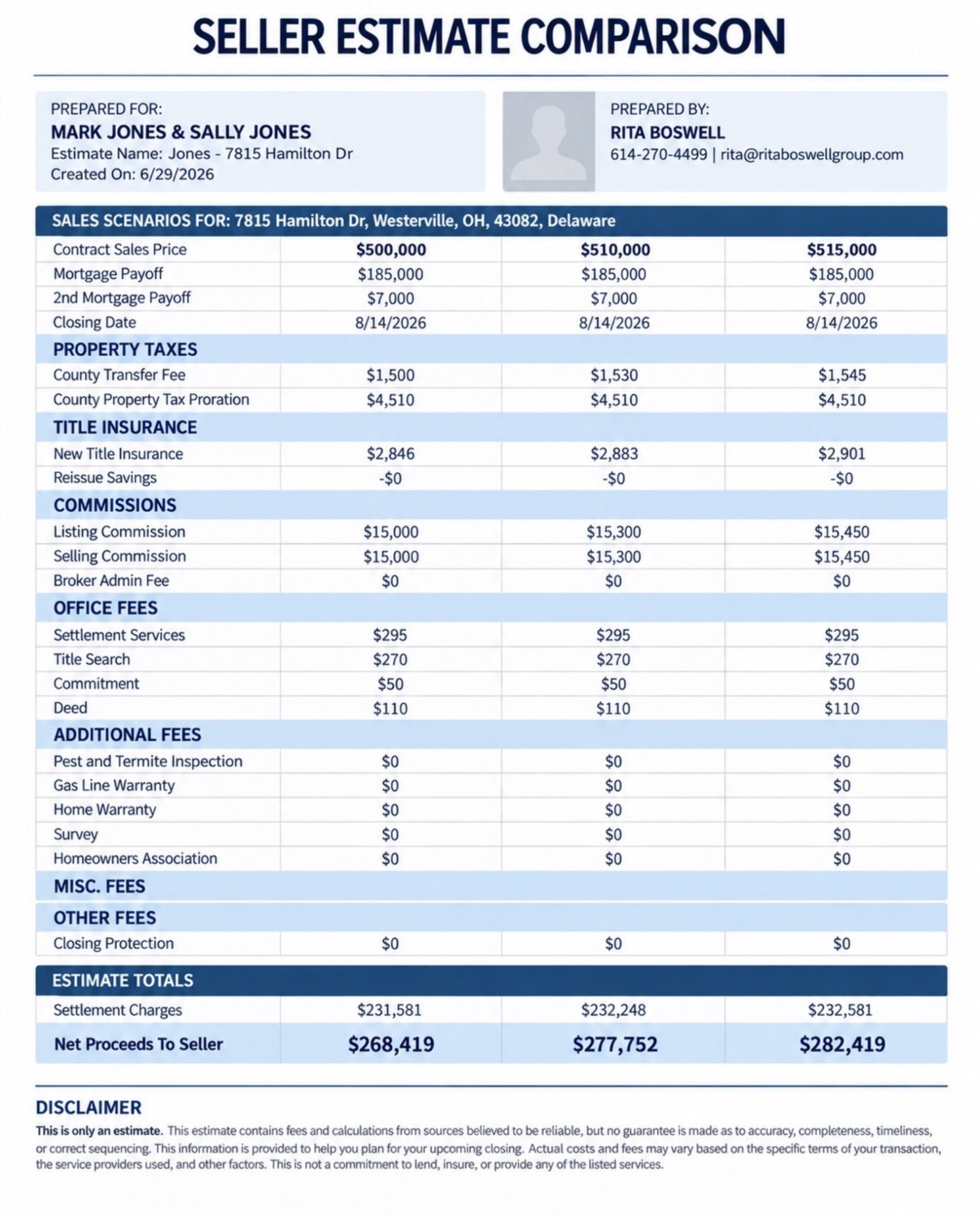
The good news is that you don't have to wait until closing to figure this out. I prepare estimated net sheets for sellers so they can see the numbers before making decisions about price, offers or their next move.
Wondering What You'll Actually Walk Away With?
I can prepare an estimated seller net sheet based on your home's potential selling price, mortgage balance and expected expenses. You'll have a clearer picture of what you could walk away with, even if you're not ready to sell just yet.
Request Your Estimated Net
Quick Answer
Your net proceeds are the money left after your home sells and your mortgage payoff, selling expenses and closing costs are deducted. For example, if your home sells for $500,000, you owe $225,000 on your mortgage and your selling expenses total $35,000, your estimated net proceeds would be $240,000. An estimated seller net sheet can help you calculate this before listing your home.
Quick Guide
What does "net proceeds" mean when selling a home?
Your net proceeds are what's left after the sale closes and the expenses associated with the sale have been paid.
The simplified calculation looks like this:
Sale Price
− Mortgage Payoff
− Selling & Closing Costs
= Estimated Net Proceeds
For example, let's say your home sells for $500,000. You owe approximately $225,000 on your mortgage and your total selling and closing expenses are approximately $35,000.
$500,000 − $225,000 − $35,000 = $240,000 estimated net proceeds.
That's a simplified example, but it's a much more useful number when you're trying to decide whether selling makes sense. The $35,000 is an illustration, not a standard amount every seller should expect to pay.
Is my home equity the same as what I'll net when I sell?
Not quite. If your home is worth $500,000 and you owe $225,000, you have approximately $275,000 in equity. But that doesn't mean you'll receive $275,000 when you sell.
There are costs involved in selling and closing the transaction. Those expenses come out of your equity before the remaining proceeds are paid to you.
Equity tells you roughly what you own. Net proceeds tell you approximately what you could walk away with.
What comes out of the sale price before you get your proceeds?
Your sale price is the number everyone sees. Your net proceeds are the amount you actually walk away with, and there are several deductions between the two.
The biggest one for many sellers is the mortgage. Your remaining mortgage balance is paid off at closing, along with any second mortgage, home equity line of credit or other lien that needs to be satisfied.
There are also expenses associated with selling and closing the home. Depending on the property and the terms of your contract, these may include:
- Title and closing charges
- Property tax prorations
- County conveyance fees
- Real estate compensation
- HOA or condominium fees, when applicable
- Seller-paid buyer closing costs or concessions
- Repair credits and other negotiated expenses
Some of those numbers can be estimated before you ever put the house on the market. Others aren't known until we have an actual offer.
That's why I prefer to prepare a seller net sheet rather than simply subtracting your mortgage from an estimated sale price. It gives you a much better picture of what you may actually have available for your next move.
How do I find my exact mortgage payoff amount?
Your current mortgage balance and your final payoff aren't necessarily the same number.
Your lender calculates the official payoff based on the date the loan will actually be paid. It can include interest through that date and other amounts due under the loan. If you have a second mortgage or home equity line of credit, that needs to be accounted for as well.
For an initial net sheet, your current mortgage balance usually gives us enough information to prepare a reasonable estimate. Once you're under contract, the title company obtains the official payoff information needed for closing.
In plain English: Your estimated net proceeds are your sale price, minus your mortgage and other loan payoffs, minus the costs associated with selling and closing the home.
How much will my selling and closing costs actually be?
This is where I think an individual net sheet becomes much more useful than a general percentage you find online.
Two Central Ohio homes selling for the exact same price can have different seller proceeds. Property taxes can be different. One property may have an HOA. One seller may agree to contribute toward a buyer's expenses. The terms negotiated in the purchase contract can also change the final number.
Real estate compensation is another expense that needs to be included. Rather than using a generic percentage, I calculate the actual amount based on the terms we've discussed so you can see what it means in dollars.
Before you make a decision about selling, I can run several scenarios using different sale prices and estimated expenses. Then you're not trying to work backward from a percentage or an online calculator. You're looking at numbers that are much closer to your actual situation.
What happens to my property taxes when I sell?
Property taxes are one of the areas that can be confusing on an Ohio closing statement because Ohio generally collects real estate taxes in arrears.
When you sell, taxes are typically prorated according to the terms of your purchase contract. That means the seller generally provides a credit for the applicable period of ownership that hasn't yet been paid through the regular tax billing process.
That doesn't necessarily mean you're being charged an extra tax. It's part of accounting for the portion of the taxes associated with the time you owned the property.
This is one of those expenses that's much easier to understand when you're looking at an actual estimated net sheet rather than trying to calculate everything yourself.
Does the offer price tell me which offer will net me the most?
Not always. Let's say you receive two offers. One buyer offers $505,000 but asks you to contribute $10,000 toward their closing costs. Another offers $500,000 without that concession.
Before accounting for other expenses, the first offer leaves $495,000 after the concession, while the second leaves $500,000. The higher-priced offer could actually put less money in your pocket.
There can be other differences too. Buyer broker compensation, repair requests, home warranties and other negotiated terms can change your final proceeds.
The highest offer isn't necessarily the best offer. What matters is what the offer means for you after all of the terms are considered.
When I'm reviewing multiple offers with a seller, that's one of the numbers I pay close attention to. Financing, contingencies and the likelihood of reaching closing also matter.

What if I don't know what my home will sell for yet?
You don't need an exact sale price to start planning. I can prepare estimated net sheets at several possible selling prices. We might look at what you could net at a conservative sale price, what the numbers look like at the price I believe the market supports, and what changes if the home sells for more.
If you're still trying to determine a realistic starting value, my guide to how much your Columbus, Ohio home is worth explains how I evaluate comparable sales, condition, location and current competition.
This can be especially important if you're using the proceeds from your current home for the down payment on another home, you're downsizing, paying off debt or trying to determine how much cash you'll have available after closing.
Instead of asking only, "What can I sell my house for?" we can answer the question that may matter even more: "What will I have left after I sell it?"
Can my estimated net change before closing?
Yes. An estimated net is exactly that, an estimate. The final number can change because of the actual sale price, mortgage payoff, closing date, tax prorations, negotiated repairs, credits or other terms of the contract.
That's why I update the numbers as we move through the transaction. You should have a pretty good idea of what you're walking away with well before you're sitting at the closing table.
Should I calculate my net before deciding to sell?
I think so, especially if the amount you'll receive affects what you plan to do next.
You don't have to list your home to find out. We can start with an estimated market value, look at your approximate mortgage balance and run several possible scenarios. Sometimes sellers discover they have more equity than they realized. Other times the numbers tell us that waiting may make more sense.
Either way, it's better to make the decision with real numbers in front of you.
The Front Porch Report
Practical advice, real stories and Central Ohio market insights to help you make smarter selling decisions.
Get The Front Porch ReportHow can I find out what I might net from selling my Central Ohio home?
If you're considering selling, I can prepare an estimated seller net sheet based on your home, approximate mortgage balance and likely selling price.
You don't need to be ready to put your house on the market. Sometimes you simply need the numbers so you can decide what makes sense.
Selling a home doesn't have to feel complicated. I guide you through the numbers, the preparation, the offers and the closing so you understand what you're agreeing to and what it means financially.
Thinking about selling?
If you're considering selling a home in Central Ohio, call or text me at 614-270-4499. I'll help you look at the numbers and figure out what your next move could look like.
Frequently Asked Questions About Seller Net Proceeds
How do I calculate how much I'll make when I sell my house?
Start with the expected sale price, then subtract your mortgage payoff and estimated selling and closing expenses. What's left is your estimated net proceeds.
Is home equity the same as net proceeds?
No. Equity is generally the difference between your home's value and what you owe against it. Net proceeds also account for the costs involved in selling and closing the transaction.
Does my mortgage balance come out of my sale proceeds?
Yes. Your mortgage and any other liens or loans secured by the property generally need to be paid from the proceeds when the home is sold.
Can I estimate my net proceeds before listing my home?
Yes. An estimated seller net sheet can be prepared using a projected sale price, your approximate mortgage balance and expected selling expenses. You can also compare several potential sale prices before deciding whether to list.
Can two offers at different prices give me the same net proceeds?
Yes. A higher-priced offer may include seller-paid closing costs, concessions or other expenses that reduce your proceeds. This is why it's important to compare the complete financial terms of an offer rather than looking only at the purchase price.
Categories
Recent Posts









GET MORE INFORMATION