
Selling Your Home in Ohio? What Your Property Tax Bill and Auditor Value Really Mean
When new auditor values arrive in the mail, most homeowners read the number one of two ways. Either my home is worth more, or my taxes are about to jump. If you're thinking about selling in the next year or two, neither reading is quite right.
Here's the short version. Your auditor's value and your tax bill tell you what you owe. They tell you very little about what your home would sell for. I think of them as two separate conversations: one about what you owe, and one about what you own.
I'm happy to pull the sales a buyer would actually compare with your home, so you have a real number to set beside the auditor's.

In Ohio, your property tax bill is built from 35% of the county auditor's value, then adjusted by voted levies, state reduction factors and credits. The auditor's value is a mass estimate from neighborhood sales, so it isn't your sale price, and buyers and appraisers don't price from it. When you sell, taxes are paid about a year behind, so they show up as a proration on your closing statement. If you live in your home, check that the owner-occupancy credit is on your bill, and know that your credits don't follow you to your next home.
Ohio property taxes work the same way whether you're selling in Powell, Dublin, Westerville, Lewis Center, Worthington, Delaware or Galena. The levies and the calendar are what change from county to county.
- Is the auditor's value what my home would sell for?
- How is an Ohio property tax bill calculated?
- Which Ohio property tax credits are changing?
- How do property taxes work when you sell a house in Ohio?
- Should you challenge your auditor's value before you sell?
- Do your Ohio tax credits move with you to your next home?
Is the auditor's value what my home would sell for?
No. The auditor's value isn't an opinion of your home. It's an estimate built from neighborhood sales over the last three years and applied to thousands of homes at once.
It doesn't know about your updated kitchen, the view off your deck or the roof you've been putting off. Buyers don't price from it, and appraisers don't either.
So if your new value feels high, it doesn't mean buyers will pay it. And if it feels low, it doesn't cap your price. For a real number, you need the sales a buyer would actually compare with your home. That's what figuring out what your home is really worth comes down to.
How is an Ohio property tax bill calculated?
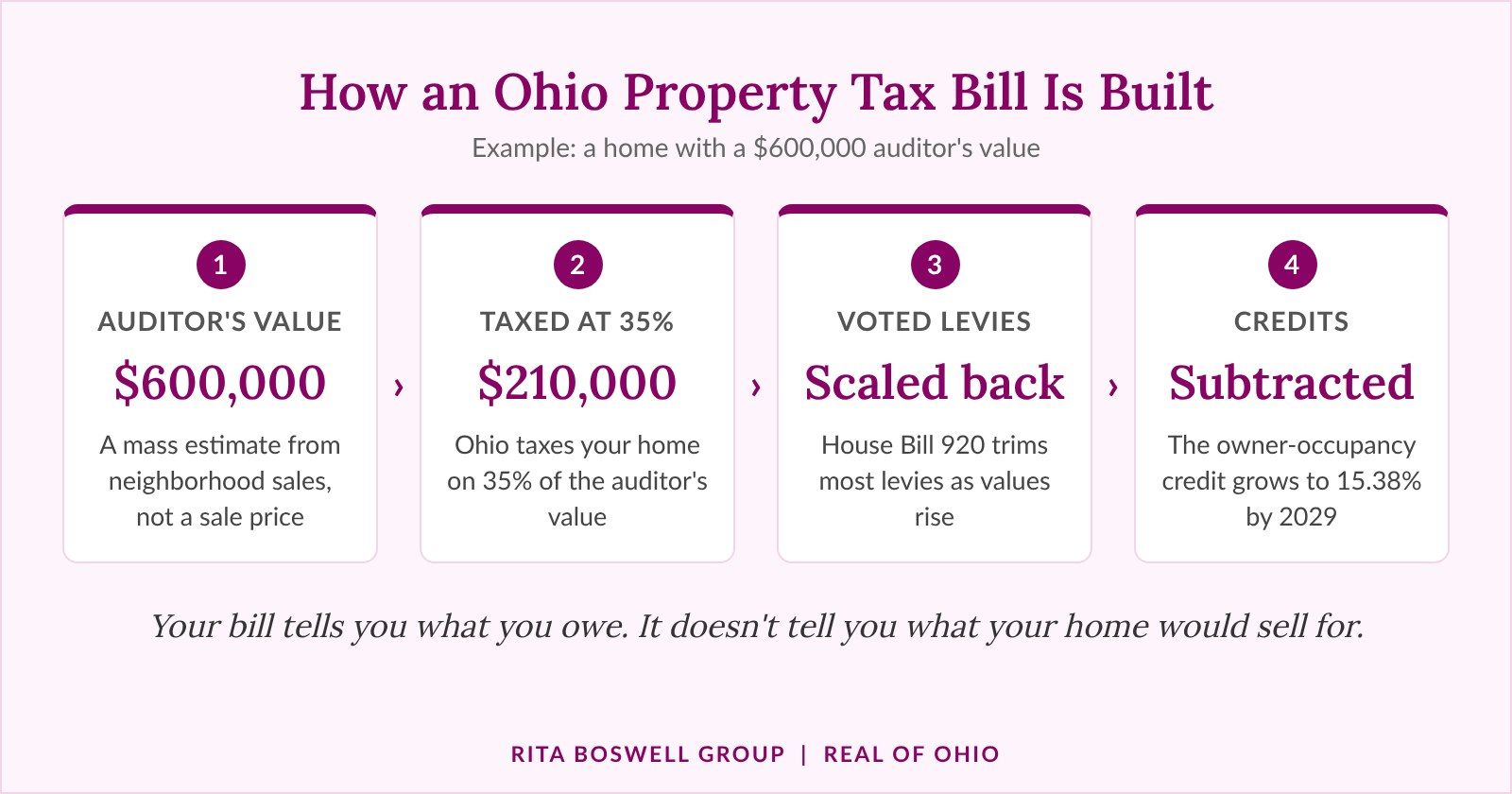
Just to give you a sense of how the pieces fit together:
It starts at 35%. Ohio taxes your home on 35% of the auditor's value. A home valued at $600,000 is taxed on $210,000.
The rate printed on your bill isn't the rate you pay. A 1976 law, House Bill 920, scales most voted levies back as values rise. That's why a 9% jump in value doesn't mean a 9% jump in taxes. Newer state laws also cap more of the automatic increases at inflation, starting with bills paid in 2027.
Buying a home doesn't reset its value. Many buyers expect the auditor's value to jump to whatever they paid. It doesn't automatically. That used to happen more often, when school districts could challenge a value right after a sale, but a 2022 state law limited that to sales at least $500,000 above the auditor's number. A sale price does become one of the neighborhood sales the auditor studies at the next update.
Which Ohio property tax credits are changing?
Ohio is folding two familiar credits into one. The 10% credit nearly every home received is phasing out, and the owner-occupancy credit grows from 2.5% to 15.38% by 2029.
If you live in your home and that credit is on your bill, you come out a little ahead. If it isn't, you lose ground every year.
Take two minutes with your current bill and look for the owner-occupancy credit. If it's missing and you owned and lived in the home on January 1, you can still apply with the auditor through December 31.
Your tax bill tells you what you owe. It doesn't tell you what your home is worth. Keep those two numbers in separate conversations, and check that the owner-occupancy credit is on your bill before you plan a move.
How do property taxes work when you sell a house in Ohio?
You're always paying a year behind. The bill you pay in 2027 covers 2026.
That's why the tax line on a closing statement can feel like paying twice when you sell. It isn't. You're covering the time you owned the home that hasn't been billed yet. But it belongs in your numbers from day one.
For the full picture of what you walk away with, including that proration, see how much you'll net from selling your home.
Should you challenge your auditor's value before you sell?
When new values come out, I sometimes hear from homeowners who feel their number is too high. They want to challenge it, and they ask me to pull comps.
I'm glad to help, and I approach it the same way I would if they were selling. I look for the homes a buyer would actually compare with theirs. Same neighborhood, similar size and age, similar condition. Not the highest sale on the street, and not the lowest.
That's where the two conversations meet. The county Board of Revision is asking the same question a buyer would ask: what have homes like yours really sold for? The value is set as of January 1, so the sales closest to that date carry the most weight, not whatever sold last month.
Those comps either make a clear case for a lower number or show the auditor was closer than it felt. Either way, you walk away with a real number.
A few dates worth knowing. 2026 is an update year for both Franklin and Delaware counties. That's the lighter check between full reappraisals, built from 2023 through 2025 sales rather than new inspections. In Franklin County, tentative values for homes rose about 9% on average, a much smaller move than the jump of roughly 40% in 2023. The new values become final in December and show up on the bills you'll pay in 2027.
Franklin County is already accepting 2026 challenges, through March 31, 2027, and Delaware County's deadline is also March 31. You generally get one filing per cycle. The state pushed the next full reappraisal in both counties back a year, to 2030, so this cycle runs four years. Make it count.
Do your Ohio tax credits move with you to your next home?
No. At your next home, the owner-occupancy credit and the homestead exemption both need a new application, and they start with the first January 1 you own and live there.
If you're 65 or older and already had the homestead exemption back in 2013, that status follows you without an income test, as long as you file the addendum at your new address. Newer applicants face a $41,000 income limit, so that older status is worth protecting.
If you're moving up or downsizing, it's worth adding these filings to your moving checklist so nothing lapses.

Related Reading
The Front Porch Report
Practical advice, real stories and Central Ohio market insights to help you make smarter selling decisions.
Subscribe to The Front Porch ReportThinking About Selling in Central Ohio?
If your new auditor value has you wondering what your home would really sell for, that's an easy question to answer together. I'll look at the sales a buyer would compare with yours and give you a real number, with no pressure attached.
Frequently Asked Questions About Ohio Property Taxes When Selling
Is the county auditor's value the same as my home's market value?
No. The auditor's value is a mass estimate built from neighborhood sales and applied to thousands of homes at once. It doesn't account for your home's condition or updates, and buyers and appraisers don't price from it. A comparison with recent sales of similar homes gives you a more useful number.
How are property taxes calculated in Ohio?
Ohio taxes your home on 35% of the auditor's value, so a home valued at $600,000 is taxed on $210,000. Voted levies are then applied, and House Bill 920 scales most of them back as values rise. Credits such as the owner-occupancy credit reduce the bill further.
Does selling my house change the auditor's value for the buyer?
Not automatically. Since a 2022 state law, a school district can challenge a value based on a sale only when the price is at least $500,000 above the auditor's number. The sale does become one of the neighborhood sales the auditor studies at the next update.
Why do I owe property taxes at closing when I sell in Ohio?
Ohio property taxes are paid about a year behind, so the bill you pay in 2027 covers 2026. At closing, the unbilled taxes for the time you owned the home are prorated on your settlement statement. It can feel like paying twice, but it covers a period that hasn't been billed yet.
Can I still get the owner-occupancy credit this year?
If the credit is missing from your bill and you owned and lived in the home on January 1, you can apply with your county auditor through December 31. The credit is growing to 15.38% by 2029 as the older 10% credit phases out, so it's worth confirming it's on your bill.
Does the homestead exemption transfer to my new home in Ohio?
The homestead exemption and the owner-occupancy credit both need a new application at your next home, starting with the first January 1 you own and live there. If you're 65 or older and had the homestead exemption in 2013, that status follows you without an income test as long as you file the addendum. Newer applicants face a $41,000 income limit.
This article is general information, not tax advice. Your actual bill depends on your county, your levies and the credits on your account. For a specific tax question, talk with a CPA or your county auditor's office. Source: Ohio Revised Code Chapters 319, 323 and 5715; House Bill 920 (1976); House Bill 126 (2022); House Bill 186 (2025); Franklin County Auditor and Delaware County Auditor; The Front Porch Report, Issue #37.
Rita Boswell is a Dublin-based Realtor with Real of Ohio who helps move-up and downsizing homeowners sell in Powell, Dublin, Westerville, Lewis Center, Worthington, Delaware and Galena.
Representing Central Ohio Homes with Real of Ohio
Categories
Recent Posts





GET MORE INFORMATION