
Seller Closing Costs in Ohio: The Conveyance Fee, Property Tax Proration, and What Else to Expect
Say you're looking at your first estimated settlement statement. You expected the payoff and the commission. Then you see a line for a conveyance fee, a credit to the buyer for property taxes, and a few title charges you've never heard of.
Here's the short version. Most of those lines are routine, and almost all of them can be estimated before you ever list. In Ohio, the two that surprise sellers most are the conveyance fee and the property tax proration, and both are easy to plan for once you know how they work.
I'm happy to walk through an estimated net sheet for your home, line by line, so nothing on closing day is a surprise.

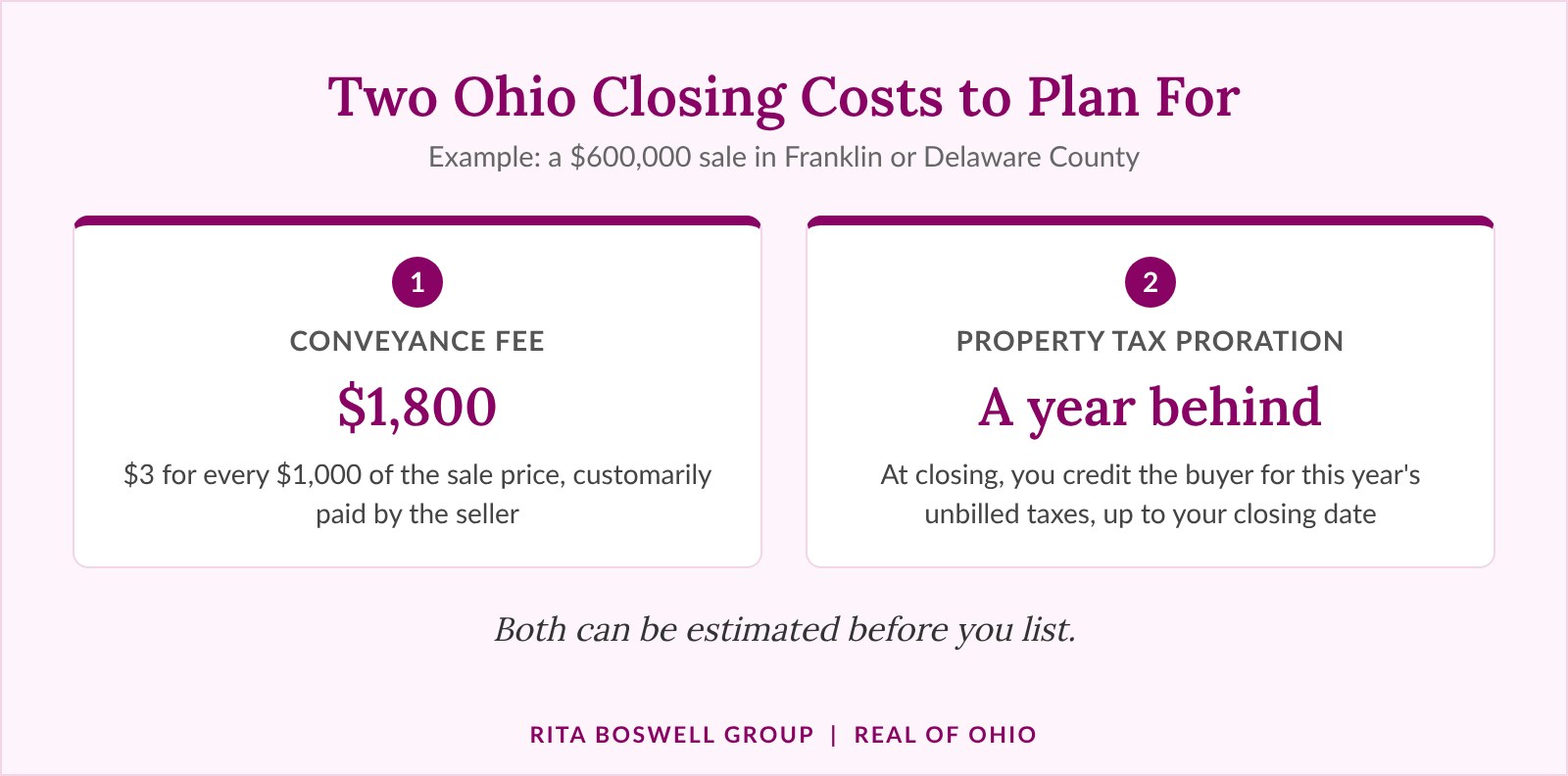
Seller closing costs in Ohio usually include the county conveyance fee, a credit to the buyer for property taxes you owe but haven't been billed for yet, your mortgage payoff, and a handful of title and deed charges. In Franklin and Delaware counties, the conveyance fee is $3 for every $1,000 of the sale price, and it's customarily paid by the seller. Because Ohio property taxes are paid a year behind, the tax proration often lands as a credit to the buyer on your side of the statement. Your purchase contract decides who pays what, so those numbers belong in your plan before you sign.
These costs work the same way whether you're selling in Powell, Dublin, Westerville, Lewis Center, Worthington, Delaware or Galena.
- What is the conveyance fee when you sell a house in Ohio?
- Who pays the conveyance fee in Ohio?
- How does property tax proration work when you sell in Ohio?
- Why does the tax credit feel like paying twice?
- What else shows up on an Ohio seller's closing statement?
- How do you estimate your closing costs before you list?
What Is the Conveyance Fee When You Sell a House in Ohio?
The conveyance fee is Ohio's version of a transfer tax. It's charged when the deed is filed with the county auditor, and it's based on the sale price.
It has two parts. The state requires a base fee of $1 for every $1,000 of value, and each county can add its own fee on top. Franklin and Delaware counties both add $2, so the total in both is $3 for every $1,000.
In plain numbers, a $600,000 sale carries a conveyance fee of $1,800. A $750,000 sale carries $2,250. It's not the biggest line on the statement, but it's one sellers rarely see coming.
Your county auditor has the official rate. Franklin County also has a conveyance fee calculator if you'd like to check a number yourself.
Who Pays the Conveyance Fee in Ohio?
In Central Ohio, the seller customarily pays it. That's the custom, though, not a law, and the purchase contract is what actually decides.
Most contracts in our area spell it out, and most follow the custom. If a buyer asks you to cover something unusual, or offers to take on a cost that's normally yours, it shows up in the contract terms, and it's worth reading carefully before you sign.
How Does Property Tax Proration Work When You Sell in Ohio?
Ohio property taxes are paid a year behind. The bill you pay in 2027 covers 2026. So on the day you close, you've lived in the home for months that haven't been billed yet.
Proration settles that. The title company figures the taxes that belong to your time in the home and haven't been paid, and you credit that amount to the buyer at closing. The buyer then pays the next bills when they come due.
The exact method depends on your purchase contract. Some contracts use the most recent tax bill, and some account for new values or levies. The title company follows whatever the contract says, which is one more reason to read that section before you sign rather than after.
If you'd like the bigger picture on how your bill is built and what this year's new values mean, I covered it in what your Ohio property tax bill is really telling you.
Why Does the Tax Credit Feel Like Paying Twice?
Because of the timing. Many sellers have just paid a tax bill a few weeks or months before closing, then see another tax line on the settlement statement.
It isn't a second payment for the same period. The bill you paid covered last year. The credit at closing covers this year, up to the day you hand over the keys. You're paying for time you actually owned the home, once.
Where it can feel tight is cash flow. If your taxes are paid through your mortgage escrow, that account is usually settled after the payoff, and any balance left over typically comes back to you from your lender after closing.
The conveyance fee and the tax proration aren't surprises once they're on paper. Both can be estimated from your sale price and your tax bill before you list, so put them in your numbers on day one.
What Else Shows Up on an Ohio Seller's Closing Statement?
Beyond the conveyance fee and proration, the rest of a seller's statement tends to fall into a few groups.
- Your payoff. The balance on your mortgage and any home equity line, including interest through the payoff date.
- Title and deed charges. Preparing the deed, recording-related items and the title company's settlement charges. Which side pays which of these depends on the contract and on local custom.
- Association items. If you're in a homeowners association, there may be charges for the statement of what's owed or for the transfer itself, set by the association.
- Anything you agreed to. Repair credits or concessions from your negotiations show up here too.
For the full walk from sale price to the check you actually take home, I go through every major expense in how much you'll net from selling your home.
How Do You Estimate Your Closing Costs Before You List?
You can get surprisingly close with three things in hand: a realistic price range, your most recent tax bill and a current payoff figure from your lender.
- Multiply your expected price by $3 per $1,000 for the conveyance fee.
- Look at your last full year of taxes and roughly how much of this year will have passed by your target closing date. That's the ballpark for your proration credit.
- Ask your lender for a payoff estimate, and add your association's charges if you have one.
Related Reading
- How Much Will I Net From Selling My Home?
- What Your Ohio Property Tax Bill Means When You Sell
- What Stays With the House When You Sell in Ohio?
The Front Porch Report
Practical advice, real stories and Central Ohio market insights to help you make smarter selling decisions.
Subscribe to The Front Porch ReportThinking About Selling in Central Ohio?
The best time to know your closing costs is before you pick a list price, not after you accept an offer. If you'd like a clear estimate of what you'd walk away with, I'm happy to put one together for your home.
Frequently Asked Questions About Seller Closing Costs in Ohio
How much is the conveyance fee in Ohio?
Ohio charges a mandatory conveyance fee of $1 for every $1,000 of the sale price, and each county can add its own fee. In Franklin and Delaware counties, the total is $3 for every $1,000. On a $600,000 sale, that comes to $1,800.
Does the seller pay the conveyance fee in Ohio?
In Central Ohio, the seller customarily pays the conveyance fee. That's a custom rather than a law, and the purchase contract decides who actually pays it. Read that section before you sign.
Why do I owe property taxes at closing in Ohio?
Ohio property taxes are paid a year behind, so at closing you usually owe taxes for time you've lived in the home that hasn't been billed yet. The title company calculates that amount and credits it to the buyer, who pays the next bills. The method is set by your purchase contract.
Am I paying property taxes twice when I sell?
No. The bill you paid before closing covered the previous year, and the credit at closing covers the current year up to your closing date. It can feel like paying twice because the two land close together, but each covers a different period.
How can I estimate my closing costs before I list?
Start with a realistic price range, your most recent tax bill and a payoff estimate from your lender. Multiply the price by $3 per $1,000 for the conveyance fee in Franklin or Delaware County, estimate the tax proration from your last full year of taxes, then add your payoff and any association charges.
This article is general information, not legal or tax advice. Your signed purchase contract controls who pays each closing cost and how property taxes are prorated. For a specific question, talk with an Ohio real estate attorney or a CPA. Source: Ohio Revised Code 319.54 and 322.02; County Commissioners Association of Ohio conveyance fee table (June 2026); Franklin County Auditor.
Rita Boswell is a Dublin-based Realtor with Real of Ohio who helps move-up and downsizing homeowners sell in Powell, Dublin, Westerville, Lewis Center, Worthington, Delaware and Galena.
Representing Central Ohio Homes with Real of Ohio
Categories
Recent Posts





GET MORE INFORMATION