
What Does Overpricing Your Home Actually Cost?
It's understandable to think you should list your home a little high so there's room to negotiate. If you're willing to accept $600,000, why not start at $625,000 and let the buyer work you down?
The problem is that buyers don't always respond that way. They don't necessarily see an overpriced home and make a lower offer. Many simply move on to another home that looks like a better value. By the time the price is adjusted, you've lost something that's difficult to recreate: the attention your home received when it was brand new to the market.
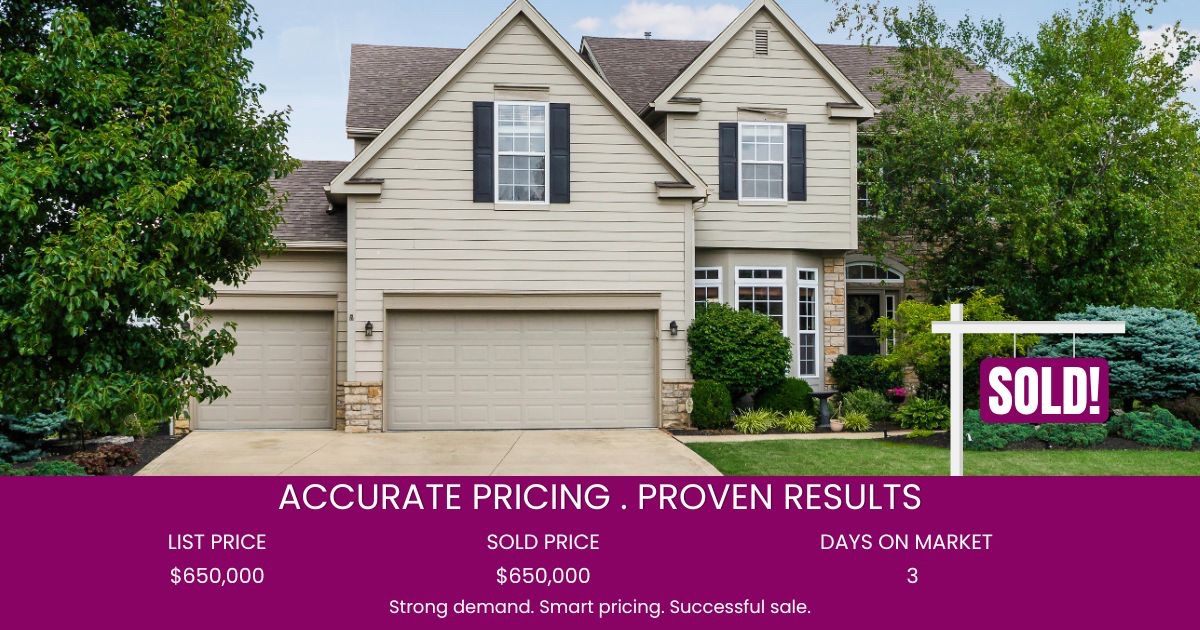
Overpricing can cost a seller in several ways. It can reduce early showing activity, increase days on market, lead to price reductions and weaken your negotiating position. Recent Dublin sales data provides a good example: homes in one price range that sold without a reduction moved considerably faster and achieved a higher sale-to-list-price ratio than homes that required a price reduction. That doesn't mean pricing was the only reason, but it's a pattern sellers shouldn't ignore.
- How can an asking price affect which buyers see your home?
- What does the market data tell us about price reductions?
- What can we learn from a real Central Ohio sale?
- Why do the first days on market matter?
- Can you fix an overpriced listing with a price reduction?
- How should you choose a listing price?
How Can an Asking Price Affect Which Buyers See Your Home?
Most sellers think about price in terms of the negotiation that happens after an offer arrives. But your asking price is doing important work long before that. It affects how buyers find your home, what other properties they compare it with and whether they decide it's worth seeing in person.
Buyers typically search within price ranges based on their budget. If your home is priced just outside the range of a group of likely buyers, some of them may never see it in their search results. At the same time, buyers searching at the higher price may be comparing your home with properties that offer more square footage, updates, a different location or other features.
That's why I don't think of pricing as simply choosing the highest number we can reasonably defend. We're deciding where the home should be positioned in the market.
The goal isn't to protect a number by pricing above it. The goal is to put your home in front of the buyers most likely to recognize its value and want to act.
Before we even get to the listing price, it helps to have a realistic understanding of what your Central Ohio home is really worth. That's the starting point for a good pricing conversation.
What Does the Market Data Tell Us About Price Reductions?
A six-month look at Dublin single-family home sales in the $450,000 to $550,000 range gives us an interesting comparison. Homes that sold without a price reduction averaged 9 days on market and sold for about 101% of their list price. Homes that required a price reduction averaged 78 days on market and sold for about 97.6% of their final list price.
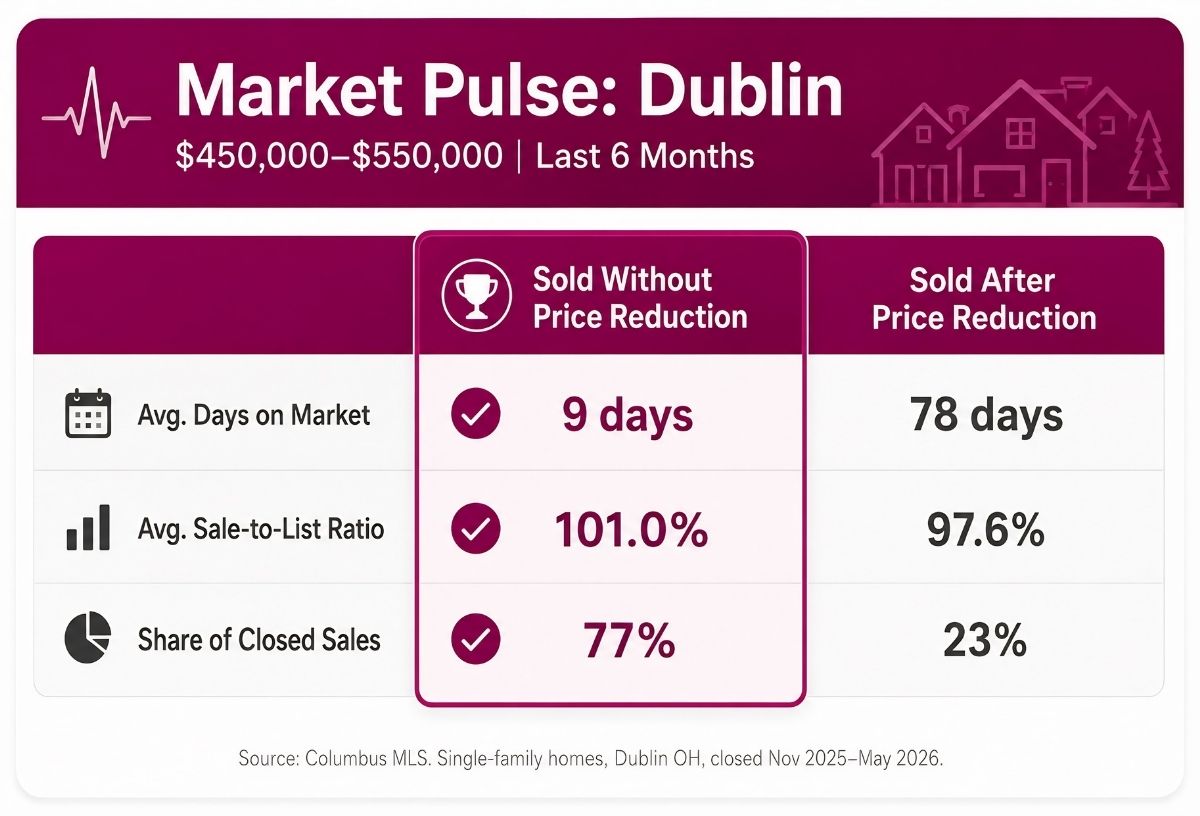
There's an important distinction here. That data doesn't prove that the original asking price caused every difference. Homes that needed reductions may also have differed in condition, location, updates or other factors.
What it does show is a pattern worth paying attention to. The homes that connected with buyers without needing a price adjustment sold much faster and at a stronger percentage of their asking price than those that needed to reposition later.
That's consistent with what I see across Central Ohio. Buyers are willing to act when they see value. When they don't, they have little reason to make an offer just because a home is available.
What Can We Learn From a Real Central Ohio Sale?
A sale in The Overlook in Westerville is a good example of why the original pricing decision deserves careful thought. The home had a lot going for it: more than 5,000 square feet, a wooded lot, walk-out lower level and three-car garage. It was listed in late October 2024 for $865,000.
After nearly three weeks without an offer, the price was reduced to $860,000. That's only a $5,000 adjustment on an $865,000 listing. It probably wasn't enough to place the home in front of a meaningfully different group of buyers or change how buyers compared it with the competition.
The home eventually sold in December for $775,000, which was $90,000 below its original asking price.
We can't know what would have happened if the sellers had chosen a different original price. Maybe the result would have changed and maybe it wouldn't have. But we do know what actually happened: the home spent several weeks at a higher price, made a small initial reduction and ultimately sold considerably below where it started.
That's why I would rather have the pricing conversation before we list than spend the next month trying to figure out how to regain buyer attention.
Why Do the First Days on Market Matter?
Your home gets its greatest advantage when it first appears as a new listing. Active buyers see it. Their agents see it. Property alerts go out. Buyers who haven't found the right house suddenly have something new to consider.
If the price and presentation make sense, that early attention can turn into showings, second showings and offers. If buyers consistently decide the home doesn't offer enough value at the asking price, those first days can pass without much response.
This doesn't mean a home has failed if it isn't under contract in a week. It means those early days give us some of our best information about how the market is responding.
I've taken a deeper look at this in why the first 10 days on market matter for Central Ohio sellers.
Can You Fix an Overpriced Listing With a Price Reduction?
Yes, sometimes a price adjustment is exactly what's needed. But waiting to correct the price isn't the same as starting at that price.
By the time you make a reduction, some buyers may have already toured the home and passed. Others may have removed it from consideration based on the original price. New buyers can certainly enter the market, and a meaningful price change can put the home in front of people who didn't see it before, but you can't completely recreate launch day.
This is also why very small reductions often don't accomplish much. Moving from $865,000 to $860,000 may technically be a reduction, but ask whether it actually changes anything. Does it reach a new buyer pool? Does it change how the home compares with the competition? Does it correct the reason buyers weren't responding?
If the answer is no, we've changed the number without really changing the strategy.
Is Price Always the Reason a Home Isn't Selling?
No, and this is an important distinction. A home can be reasonably priced and still struggle because of condition, presentation, photography, location, showing restrictions or simply because buyer demand for that particular type of property is limited.
That's why I don't believe every slow listing needs an immediate price reduction. We need to look at what buyers are telling us. Are we getting very few showings? Plenty of showings but no offers? Are buyers mentioning the same concern repeatedly? What competing homes have come on the market?
Sometimes price is the problem. Sometimes the house isn't showing as well as it could. That's why decisions about which improvements buyers actually notice should happen before the listing goes live whenever possible.
How Should You Choose a Listing Price?
When I'm sitting down with a seller, we look at comparable sales, current competition, condition, updates, lot, location and what's happening in that particular part of the market. I can look at those numbers inside out and upside down, but in the end it's what a buyer is willing to pay.
My goal isn't to convince a seller to list low. It's to position the home where the right buyers see the value and want to act. That's very different from choosing the highest number we think we might be able to defend.
You can read more about how to price your Central Ohio home correctly, but the basic idea is simple: pricing should help create buyer interest, not become something we have to overcome.
"A strong pricing strategy isn't about giving your home away. It's about creating enough buyer interest that you have options."
And if those options turn into multiple offers, don't assume the biggest number automatically wins. There are several other things to consider when deciding whether you should accept the highest offer on your home.
Thinking About Selling Your Central Ohio Home?
If you're considering selling, it's never too early to start looking at the numbers. I'll help you understand where your home realistically fits in the current market, what I would recommend doing before you list and how I would approach the pricing strategy.
The goal isn't simply to put your home on the market. It's to have a plan before it gets there.
The Front Porch Report
Practical advice, real stories and Central Ohio market insights to help you make smarter selling decisions.
Join the Front Porch ReportOne email every Tuesday. Unsubscribe anytime.
Frequently Asked Questions About Overpricing Your Home
Can overpricing my home cause it to sell for less?
Should I price my home higher so I have room to negotiate?
How do I know if my home is overpriced?
Will a price reduction bring buyers back?
Is price always the reason a home sits on the market?
What's the best way to determine my home's listing price?
Data referenced: Columbus MLS single-family home sales in Dublin, Ohio, $450,000 to $550,000 price range, analyzed over a six-month period. Market conditions change, and individual results vary by property, location, condition, price range and timing.
Rita Boswell is a Central Ohio real estate agent with Real of Ohio, helping homeowners throughout the Columbus area understand their home's value, prepare for the market and make informed pricing decisions.
Representing Central Ohio Homes with Real of Ohio
Categories
Recent Posts





GET MORE INFORMATION