
2026 Columbus & Central Ohio Housing Market Outlook: What Sellers Needed to Know
Heading into 2026, the Columbus and Central Ohio housing market looked very different from the extremes homeowners experienced a few years earlier. National forecasters were generally expecting slower price growth, mortgage rates around the 6% range and a gradual increase in home sales. At the same time, Central Ohio was entering the year with more homes for sale, longer market times and prices that were still higher than the year before.
For sellers, I thought the most important part of that story was not whether one forecast predicted 1% appreciation and another predicted 4%. It was that the market was becoming more balanced. Buyers had more choices, which meant pricing, preparation and knowing how your home compared with the competition mattered more.
This article looks back at the information available as we entered 2026 and what those numbers suggested for Central Ohio homeowners considering a move.

Heading into 2026, the broad expectation was for a more balanced housing market rather than a major boom or downturn. National forecasts generally pointed toward modest price growth and mortgage rates near 6%, while late-2025 Columbus and Central Ohio data showed more inventory, longer market times and continued year-over-year price growth. For sellers, that suggested a market where buyers were still active but had more room to compare homes and negotiate.
What Were National Forecasters Expecting for 2026?
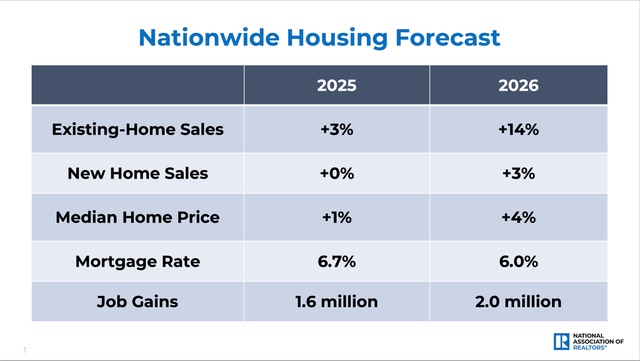
The major national housing forecasts did not agree on every number, but most were pointing in the same general direction: slower price growth, mortgage rates remaining relatively elevated and more housing activity than the very slow market of the previous few years.
What were forecasters saying about home prices?
The forecasts referenced in the original analysis generally expected national home prices to continue increasing, but at a much slower pace than homeowners had become accustomed to earlier in the decade.
The estimates varied. Some forecasts were close to flat while others expected several percentage points of appreciation. I would not put too much weight on the exact number because national appreciation doesn't tell us what an individual home in Powell, Dublin, Westerville or Lewis Center will do.
The more useful takeaway was that the consensus at the time did not point toward a major nationwide price correction.
What about mortgage rates?
Most of the forecasts used in this article expected mortgage rates to remain around the low-6% range through much of 2026.
For homeowners with mortgages in the 3% or 4% range, that was still a significant difference. The rate alone, though, wasn't enough to answer whether moving made financial sense. Equity, sale proceeds, the price of the next home and the new monthly payment all had to be considered together.
Were home sales expected to increase?
Forecasters generally expected more people to move in 2026, although the predictions varied substantially. Some expected only modest improvement while others predicted a much larger increase in existing-home sales.
That range is a good reminder that a forecast is an estimate, not a promise. What mattered to me was the direction: economists broadly expected some of the housing-market gridlock to begin easing.
Entering 2026, the expectation was not for another dramatic housing cycle. It was for a market that gradually became more functional, with somewhat more inventory, modest price movement and more homeowners willing to make a move.
What Was Happening in Central Ohio as We Entered 2026?
The late-2025 Columbus REALTORS® data gave us something more useful than a national forecast because it showed what buyers and sellers were actually doing locally.

| Market Measure | November 2025 | Year-over-Year Change |
|---|---|---|
| Closed Sales | 2,193 | +2.2% |
| Median Sale Price | $325,000 | +3.2% |
| Average Days on Market | 40 days | +29% |
| Homes for Sale | 5,497 | +19.5% |
| New Listings | 2,218 | +0.6% |
That combination is important. Prices were still higher than the year before, but homes were taking longer to sell and buyers had substantially more properties to choose from.
That does not describe a collapsing market. It describes a market moving away from extreme scarcity.
Where Did the National and Central Ohio Stories Line Up?
Both pointed toward more balance.
National economists were expecting affordability and sales activity to improve gradually. Locally, inventory was already increasing and market times had stretched while prices were still holding above the year before.
For sellers, that meant the strategy that worked during the most competitive years of the market wasn't necessarily the strategy that would work in 2026.
When buyers have more choices, they can be more selective. They compare price, condition, location and presentation instead of simply asking whether they can get the house at all.
That's where preparation becomes more important. My guide to what to fix before listing your home explains where I would focus before spending money.
And if you're trying to decide whether a larger improvement is worth doing, read what actually adds value before selling.
What Did This Mean for Central Ohio Sellers?

I thought the biggest risk entering 2026 was assuming that rising prices meant sellers could be aggressive with their asking price.
Those are two different things.
A market can appreciate overall while individual homes still struggle because they are positioned above where buyers see value.
That is why I would start with what your Central Ohio home is realistically worth, then decide how to position it against the homes buyers can choose from today.
If the market is giving buyers more options, pricing becomes more important, not less. My article about how to price your home correctly goes deeper into that strategy.
Overpricing also becomes harder to recover from when buyers don't feel urgency. You can see why in what overpricing a home can actually cost.
And once the home goes live, the early buyer response gives us valuable information. That's why I pay so much attention to the first 10 days on market.
"A more balanced market doesn't mean sellers lose. It means the home has to make sense to the buyer."
Did More Inventory Hurt Sellers?
Not necessarily.
More inventory means more competition, but it can also make moving easier for the homeowner who needs to buy something after selling.
One of the biggest reasons homeowners stayed put in the previous few years was that they couldn't find a next home they wanted to buy. A gradual improvement in inventory can help solve that problem.
So instead of looking at inventory only from the perspective of “more competition,” I would look at both sides of the move. What could you sell your current home for, and what choices would you have after you sell?
What Couldn't the 2026 Forecasts Tell Us?
They couldn't tell us what an individual home would sell for. They couldn't tell us exactly where mortgage rates would be six months later. And they certainly couldn't tell us whether a particular seller should move.
Forecasts are useful for understanding direction, but real estate decisions happen at a much smaller level.
A $450,000 home in Westerville can behave differently from an $850,000 home in Dublin. A property in Lewis Center may be competing with nearby new construction while a home in Worthington may be competing with older resale inventory.
Even two homes in the same neighborhood can perform differently based on condition, lot, layout and pricing.
That is why I would use the national forecasts as context and the local data as direction, then make the actual decision based on your house and what you plan to do next.
This article reflects the forecasts and Central Ohio data available as the market entered 2026. It is a historical outlook, not a statement of current market conditions.
What Should Sellers Focus on Instead of Trying to Predict the Market?
I would focus on the things you can actually control.
Understand your home's value. Decide what is worth doing before you list. Look closely at the competition. Price strategically. And have a plan for where you are going next.
If offers arrive, don't automatically assume the biggest number is the best one. Financing, inspections, appraisal risk, closing timing and other terms matter too. My guide to whether you should accept the highest offer on your home explains how I evaluate those tradeoffs.
Thinking About Selling Your Central Ohio Home?
If you're considering a move, you don't need to base the decision on a national forecast. We can look at what your home is worth, what is currently competing with it and how the numbers work for whatever comes next.
Selling doesn't have to feel overwhelming. The important part is starting with the right information rather than trying to guess where the market will be six months from now.
The Front Porch Report
Practical advice, real stories and Central Ohio market insights to help you make smarter selling decisions.
Join the Front Porch ReportOne email every Tuesday. Unsubscribe anytime.
Frequently Asked Questions About the 2026 Central Ohio Housing Market Outlook
What were housing forecasters expecting for 2026?
Was the Central Ohio housing market weakening as 2026 began?
Did more homes for sale mean Central Ohio sellers were in trouble?
Were Central Ohio home prices expected to fall in 2026?
Should a homeowner wait for mortgage rates to fall before selling?
Can a housing forecast tell me the best time to sell my home?
Sources referenced in the original outlook included the National Association of REALTORS®, Fannie Mae, Realtor.com, Redfin, Moody's Analytics and Columbus REALTORS®. Forecasts were estimates available as the market entered 2026 and should not be interpreted as guarantees or current market conditions.
Rita Boswell is a Central Ohio real estate agent with Real of Ohio, helping homeowners throughout the Columbus area understand their options, prepare for the market and make informed decisions about selling and what comes next.
Representing Central Ohio Homes with Real of Ohio
Categories
Recent Posts






GET MORE INFORMATION